Why Your Hydrangea Didn’t Bloom (The Pruning Timing Problem)
Hydrangeas are not one plant — they are a genus of flowering shrubs with fundamentally different bloom strategies. Some species flower on old wood (stems produced last summer). Others flower on new wood (stems produced this spring). A few flower on both. Pruning at the wrong time for your species is the horticultural equivalent of deleting a document before you print it.
The Three Bloom Strategies
| Bloom Type |
What It Means |
Affected Species |
Pruning Window |
| Old wood (previous season’s growth) |
Flower buds formed in late summer/early fall on stems that grew this year; they overwinter on the plant |
Bigleaf (H. macrophylla), Oakleaf (H. quercifolia), most Mountain (H. serrata) |
Immediately after flowering (late summer); minimal spring cleanup only |
| New wood (current season’s growth) |
Flower buds form in spring on new stems that emerge from the base or from last year’s framework |
Panicle (H. paniculata), Smooth (H. arborescens) |
Late winter/early spring before new growth; can be cut back hard annually |
| Both old and new wood (remontant/reblooming) |
Blooms on old wood first, then produces new wood flowers for a second flush |
Some modern Bigleaf cultivars (Endless Summer, Let’s Dance series) |
Light spring cleanup of dead wood; deadhead to encourage rebloom |
The critical insight: If you have a bigleaf hydrangea (the classic blue or pink mophead or lacecap) and you prune it in late winter or early spring, you are cutting off every flower bud that formed the previous August. The plant will grow beautiful leaves and zero blooms. This is the #1 reason gardeners think their hydrangea is “finicky” or “not blooming.” It’s not finicky — it was decapitated at the wrong season.
How to Identify Your Hydrangea Type (Before You Touch a Pruner)
You cannot prune correctly if you don’t know what you’re growing. Here’s my field identification guide.
Bigleaf Hydrangea (Hydrangea macrophylla)
-
Leaves: Large, glossy, dark green, somewhat heart-shaped or rounded, serrated edges, 4–8 inches long
-
Flowers: Mophead (round, globe-shaped clusters) or Lacecap (flat, delicate centers with showy outer petals)
-
Colors: Blue in acidic soil, pink in alkaline soil, white varieties exist
-
Stems: Relatively thin, somewhat brittle, often die back partially in cold winters
-
Bloom time: June–July (earliest of the common garden types)
Panicle Hydrangea (Hydrangea paniculata)
-
Leaves: Medium, pointed, slightly rough texture, 3–6 inches
-
Flowers: Cone-shaped panicles (pyramids), white maturing to pink/red, very large (6–18 inches)
-
Colors: White → blush pink → deep rose; not pH-sensitive
-
Stems: Thick, woody, upright, very hardy
-
Bloom time: July–September (latest blooming)
-
Common cultivars: Limelight, Vanilla Strawberry, Pinky Winky, Quick Fire
Smooth Hydrangea (Hydrangea arborescens)
-
Leaves: Thin, soft, slightly fuzzy, rounded, 3–6 inches
-
Flowers: Large white globes, often 6–12 inches across, very open and airy
-
Stems: Thin, greenish, herbaceous (die to ground in cold winters)
-
Bloom time: June–August
-
Common cultivars: Annabelle, Incrediball, Invincibelle Spirit
Oakleaf Hydrangea (Hydrangea quercifolia)
-
Leaves: Distinctive oak-leaf shape, 4–8 inches, leathery, deep lobes, spectacular red-purple fall color
-
Flowers: Elongated white panicles, 4–12 inches, often held above foliage
-
Stems: Thick, cinnamon-colored, peeling bark, very architectural
-
Bloom time: May–June
-
Bonus: Winter interest from dried flower heads and exfoliating bark
Climbing Hydrangea (Hydrangea anomala subsp. petiolaris)
-
Growth: Woody vine clinging by aerial rootlets
-
Leaves: Heart-shaped, glossy, 2–4 inches
-
Flowers: Flat lacecap clusters, 6–10 inches, white
-
Bloom time: June–July
-
Location: Growing on walls, fences, trees, or structures
Pro tip from the field: If you just moved into a house and inherited an unknown hydrangea, wait until it flowers. The flower shape, leaf shape, and bloom timing will tell you everything. Do not prune until you have a positive ID. One season of patience prevents three seasons of bloom loss.
The Pruning Calendar: When to Cut What
Here’s the seasonal roadmap I use for every hydrangea in my care.
| Season |
Old-Wood Bloomers (Bigleaf, Oakleaf, Mountain) |
New-Wood Bloomers (Panicle, Smooth) |
Reblooming (Remontant) Bigleaf |
| Late winter (Feb–Mar) |
DO NOT PRUNE. Flower buds are dormant on stems. |
PRUNE NOW. Cut back last year’s stems to framework. |
Light cleanup only; remove obviously dead wood. |
| Early spring (Apr–May) |
Remove only dead wood after buds break (snip stems that show no green). |
Already done; monitor for winter damage. |
Remove dead wood; fertilize to encourage rebloom. |
| After first bloom (Jun–Jul) |
PRUNE NOW. Deadhead spent blooms; shape lightly; remove 1/3 oldest stems. |
Monitor; deadhead if desired (not necessary for bloom). |
Deadhead to encourage second flush; light shaping. |
| Late summer (Aug–Sep) |
STOP PRUNING. New flower buds are forming for next year. |
Light deadheading; minimal shaping if needed. |
Stop pruning; allow buds to set for next spring. |
| Fall (Oct–Nov) |
No pruning. Let stems harden; buds enter dormancy. |
No pruning needed. |
No pruning. |
| Winter (Dec–Jan) |
No pruning. Dried flowers provide winter interest. |
No pruning needed. |
No pruning. |
How to Prune Bigleaf Hydrangeas (Macrophylla) for Next Summer’s Blooms
This is the species that causes the most pruning anxiety — and the most pruning mistakes.
The Goal
Preserve as many healthy stems as possible because every healthy stem carries next year’s flower buds. Remove only dead, damaged, or crossing wood. Thin selectively to renew the plant without sacrificing bloom.
Step 1: Wait Until After Bloom (July–August)
Bigleaf hydrangeas should be pruned immediately after flowering finishes — typically late July to mid-August depending on your climate. This gives the plant 6–8 weeks to produce new growth and set flower buds before dormancy.
Never prune bigleaf hydrangeas in spring. I repeat this because it’s the most expensive mistake in ornamental gardening. One spring haircut = zero summer flowers.
Step 2: Identify Dead and Damaged Wood
After bloom, examine each stem. Dead wood is:
-
Brittle and snaps cleanly
-
Brown or gray inside when scratched with a thumbnail
-
Produces no leaves or buds from nodes
Cut dead wood back to the nearest living junction (where you see green tissue inside the stem).
Step 3: Remove the Oldest 1/3 of Stems (Rejuvenation Pruning)
Select the thickest, woodiest, least productive stems — usually 3–5 years old. These stems often flower weakly and contribute to a dense, congested center. Cut them back to 3–6 inches above ground level.
This opens the center for light and air, stimulates fresh basal growth, and maintains the plant’s vigor without removing all the blooming wood.
Step 4: Deadhead Correctly
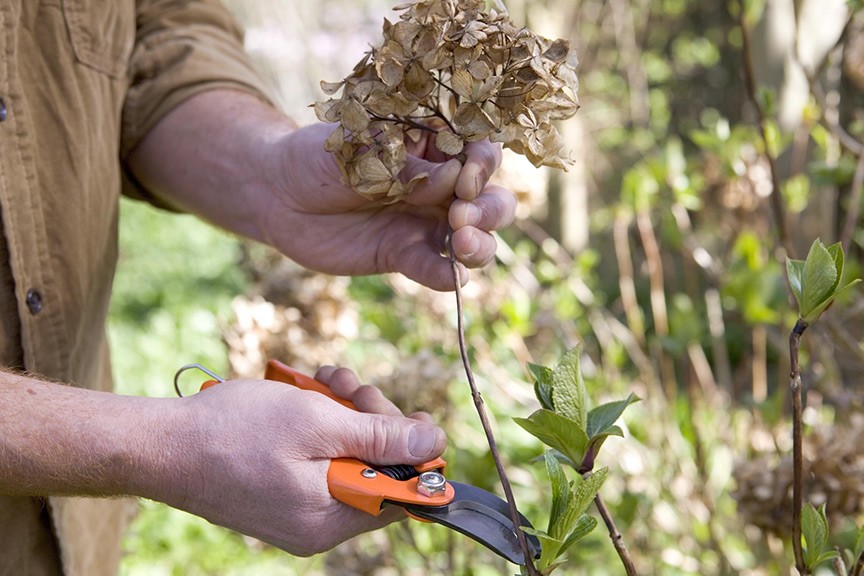
Remove spent flower heads by cutting back to the first pair of strong, healthy buds below the flower cluster. Do not cut back to bare wood below the buds — you need those buds for next year’s blooms.
If the flower stem is weak or spindly, cut it back further to a stronger lateral branch.
Step 5: Shape Lightly
Bigleaf hydrangeas have a naturally mounded habit. Prune to enhance this, not fight it. Remove stems that grow inward toward the center or cross and rub against others. Step back frequently and assess the overall silhouette.
Step 6: Stop by Mid-August
In most climates, bigleaf hydrangeas begin forming flower buds for next year in late August. Any pruning after this risks removing developing buds. If you missed the window, wait until next July.
My proprietary field technique for northern zones: In Zone 5 and colder parts of Zone 6, bigleaf hydrangeas often suffer winter dieback — stems freeze to the ground even though the roots survive. If you know your plant consistently dies back, choose a remontant/reblooming cultivar (Endless Summer, Let’s Dance) that flowers on new wood as well. Then treat it like a new-wood bloomer: prune dead stems to the ground in late spring and let the new growth carry the bloom.
How to Prune Panicle and Smooth Hydrangeas for Maximum Flower Size
These are the easy ones — but improper pruning still reduces their impact.
Panicle Hydrangeas (H. paniculata)
Timing: Late winter or early spring before new growth begins (February–March in most climates).
Method:
-
Remove any dead, damaged, or crossing branches back to the main framework.
-
Cut last year’s flower stems back to a strong pair of buds — typically 12–24 inches above the ground, depending on desired height.
-
For larger flowers (fewer but bigger), cut back to 2–3 strong buds on each stem. This concentrates energy.
-
For more flowers (smaller but abundant), leave more buds and stems.
-
Remove thin, weak stems entirely — they produce insignificant flowers and sap energy.
The “Tree Form” Exception: If your panicle hydrangea is trained as a standard (tree form with a single trunk), prune only the canopy. Remove water sprouts from the trunk and base. Thin the canopy for air circulation. Maintain the rounded shape by cutting back longest branches to outward-facing buds.
Why timing doesn’t matter as much for panicles: Panicle hydrangeas bloom on new wood. Even if you prune in late winter, every stem that emerges in spring will produce flower buds. However, pruning too late (after buds have broken) wastes the plant’s early spring energy reserves.
Smooth Hydrangeas (H. arborescens)
Timing: Late winter or early spring.
Method: Smooth hydrangeas are the most forgiving. ‘Annabelle’ and ‘Incrediball’ produce massive flowers on new growth and can be cut back hard.
-
Cut all stems back to 12–18 inches above ground level. This produces the largest flower heads.
-
For a more natural, less floppy habit, cut back to 18–24 inches and leave a framework of older stems.
-
Remove any thin, spindly growth at the base.
-
Thin to 5–7 strong stems if the plant is overcrowded.
Field note: ‘Annabelle’ is notorious for flopping under the weight of its flower heads. The harder you cut it back (to 12 inches), the larger the individual flowers — but the weaker the stems. I compromise at 18 inches for most clients, which produces strong enough stems to support the blooms without staking.
How to Prune Oakleaf Hydrangeas for Structure and Bloom
Oakleaf hydrangeas are the aristocrats of the genus — architectural, slow-growing, and long-lived. They require the least pruning of any common hydrangea.
Timing: Immediately after flowering (July) or in late winter for structural cleanup only.
Method:
-
Minimal intervention: Oakleaf hydrangeas bloom on old wood and have a naturally beautiful, irregular shape. Prune only for health and structure.
-
Remove dead or damaged wood.
-
Remove one or two of the oldest stems at ground level every 2–3 years to encourage basal renewal.
-
Deadhead by cutting back to the first strong pair of buds.
-
Never shear or shape into a ball. The exfoliating bark and irregular branching are the plant’s winter glory. Shearing destroys its character.
Winter interest: I intentionally leave dried flower heads and interesting branch structure on oakleaf hydrangeas through winter. The cinnamon bark, peeling texture, and persistent flower skeletons are stunning against snow. Prune for bloom in summer; admire the structure in winter.
How to Prune Climbing Hydrangeas Without Losing Next Year’s Display
Climbing hydrangeas are slow to establish (often 3–5 years before significant bloom) and bloom on old wood. Pruning mistakes set you back years.
Timing: Immediately after flowering (June–July).
Method:
-
Train first, prune second. Establish the climbing framework on your wall, fence, or structure before worrying about bloom.
-
Remove only dead, damaged, or badly wayward stems.
-
Cut back overlong shoots that have escaped the desired framework.
-
Remove root suckers at the base if you want to confine the plant.
-
Do not hard prune into old wood. Climbing hydrangeas resent heavy renovation and may sulk for 2–3 years.
The Rejuvenation Method (When Your Hydrangea Hasn’t Bloomed in Years)
If your bigleaf or oakleaf hydrangea has grown into a massive, unproductive thicket with few flowers, it may need radical rejuvenation.
The Three-Year Method: Instead of cutting the entire plant to the ground (which sacrifices 2–3 years of bloom), remove 1/3 of the oldest stems each year for three years.
-
Year 1: Cut the oldest, woodiest 1/3 of stems to 6 inches above ground. Leave the rest to bloom.
-
Year 2: Cut the next oldest 1/3.
-
Year 3: Cut the final oldest 1/3.
By Year 3, you have a completely renewed plant with young, vigorous, blooming wood — and you had flowers every year during the transition.
For new-wood bloomers (panicle, smooth): Rejuvenation is simpler. Cut the entire plant to 12–18 inches in late winter. It will regrow and bloom profusely on new wood the same season.
Deadheading vs. Pruning: What to Remove and What to Leave
Deadheading is not pruning. Deadheading removes spent flowers. Pruning removes stems. The distinction matters for bloom timing.
| Species |
Deadhead? |
When? |
Effect on Next Bloom |
| Bigleaf (macrophylla) |
Yes, to first strong buds |
After bloom (July–Aug) |
Tidier plant; may slightly encourage rebloom on remontant varieties |
| Panicle (paniculata) |
Optional |
Any time for aesthetics |
None — blooms on new wood; dried flowers provide winter interest |
| Smooth (arborescens) |
Optional |
Any time |
None — blooms on new wood; dried flowers persist beautifully |
| Oakleaf (quercifolia) |
Optional |
After bloom (July) |
Minimal; leave dried heads for winter beauty |
| Climbing (petiolaris) |
Rarely needed |
After bloom if unsightly |
Preserves next year’s buds |
My winter aesthetic preference: I leave dried panicle and smooth hydrangea flowers standing through winter. They catch snow, provide texture, and feed overwintering birds. I deadhead bigleaf hydrangeas in summer because their dried heads are less architectural and can harbor moisture that promotes spring crown rot.
FAQ
Q: I pruned my bigleaf hydrangea in March. Will it bloom this year? A: If you cut the stems back significantly, probably not. Bigleaf hydrangeas bloom on old wood, and you removed the buds that formed last August. However, if the plant is a remontant/reblooming variety (Endless Summer, Let’s Dance, BloomStruck), it may produce some flowers on new wood later in summer — though usually fewer and later than normal. Mark your calendar for July pruning next year.
Q: Can I prune hydrangeas in fall? A: For bigleaf, oakleaf, and mountain hydrangeas — absolutely not. Fall pruning removes next year’s flower buds. For panicle and smooth hydrangeas, you can prune in fall, but it’s unnecessary and removes the winter interest of dried flowers. Wait until late winter.
Q: My hydrangea is too big for its space. Can I cut it back hard? A: If it’s a panicle or smooth hydrangea, yes — cut it back hard in late winter. If it’s a bigleaf or oakleaf, hard pruning in the wrong season means no flowers for a year (or two). Instead, use the three-year rejuvenation method, removing 1/3 of oldest stems each summer after bloom. If you must reduce size immediately, accept that you’ll sacrifice next year’s flowers.
Q: Should I prune off the brown, dead-looking stems after winter? A: For bigleaf hydrangeas in cold climates, wait until spring buds break. Scratch the bark with your thumbnail. Green underneath means the stem is alive and carrying flower buds. Brown and brittle means it’s dead — cut it back to living tissue. For panicle and smooth hydrangeas, those brown stems are last year’s growth and can be pruned in late winter since they bloom on new wood anyway.
Q: How do I get bigger flowers on my hydrangea? A: For panicle and smooth hydrangeas, prune harder (cut back to 12–18 inches) and thin to fewer stems — 5–7 strong canes instead of 20 weak ones. Energy concentrates on fewer flowers, making them larger. For bigleaf hydrangeas, flower size is largely genetic and soil-dependent. Ensure consistent moisture and avoid high-nitrogen fertilizers that push leaf growth over blooms. If you’re amending soil around your hydrangeas, the compost you produce from your kitchen scraps can provide gentle, balanced nutrition — check out my guide on
how to compost kitchen scraps in an apartment without smell or pests for a sustainable source of organic matter.
Q: Why are my hydrangea flowers turning brown and crispy in summer? A: This is usually afternoon heat stress combined with insufficient soil moisture. Bigleaf hydrangeas are particularly susceptible. Mulch heavily (2–3 inches of shredded bark), water deeply during dry spells, and plant where they receive morning sun but afternoon shade. Dried flowers can also indicate a need for deadheading to redirect energy.
Q: Can I prune hydrangeas with hedge shears? A: Please don’t. Shearing creates a dense outer shell of foliage with a dead, airless center. It destroys the natural form, promotes disease, and on old-wood bloomers, shears inevitably remove next year’s flower buds indiscriminately. Use hand pruners and make selective cuts to individual stems.
Q: My climbing hydrangea hasn’t bloomed in 4 years. Should I prune it to force flowers? A: No. Climbing hydrangeas are notoriously slow to establish and often take 3–7 years before significant blooming. Pruning will only delay maturity further. Ensure it has adequate moisture, partial shade, and a climbing structure. Patience is the only cure.
Q: Should I fertilize my hydrangea after pruning? A: For bigleaf and oakleaf hydrangeas pruned in summer, a light application of balanced, slow-release organic fertilizer or a side-dressing of compost in early spring supports healthy growth and bud formation. For panicle and smooth hydrangeas, fertilize in early spring before new growth begins. If you’re building long-term garden fertility, the composting practices I outline in
how to compost kitchen scraps in an apartment without smell or pests can supply the steady, low-nitrogen organic matter hydrangeas prefer.
Conclusion
Hydrangeas are not difficult plants — they are specific plants. The difference between a hydrangea that blooms gloriously every June and one that sulkily produces foliage all summer comes down to one question: Are you pruning with the plant’s biology or against it?
Identify your species first. Bigleaf and oakleaf bloom on old wood — prune them in summer after flowering, never in spring. Panicle and smooth bloom on new wood — prune them in late winter without fear. Remontant bigleaf varieties give you more flexibility but still prefer summer shaping.
Prune for purpose, not habit. Remove dead wood. Remove oldest stems for renewal. Remove crossing branches for health. Deadhead for tidiness. But never shear indiscriminately, never prune old-wood bloomers in spring, and never hard-prune a climbing hydrangea unless you’re prepared to wait years for forgiveness.
The three-year rejuvenation method transforms an overgrown, non-blooming bigleaf thicket into a vigorous, floriferous shrub — while preserving annual flowers. The hard late-winter cutback turns a floppy smooth hydrangea into a pillar of massive white blooms.
And remember: the best fertilizer for next year’s flowers is the bud you preserve this year. Put down the pruners in March. Pick them up in July. Your hydrangea will thank you with a display that stops traffic.
Last updated: June 2026 | Pruning recommendations reflect current horticultural best practices for Hydrangea species in USDA Hardiness Zones 4–9. Adjust timing based on your local climate and species identification.
About the author: I’m an estate garden manager and hydrangea specialist with 15 years of hands-on experience maintaining specimen collections, rejuvenating overgrown plantings, and coaching homeowners through pruning timing across the Northeast and Pacific Northwest. I write detailed seasonal guides so gardeners can achieve professional-grade bloom displays — without the heartbreak of spring-pruned, flowerless shrubs.